
Menorca's unspoilt coves: which they are and how to reach them
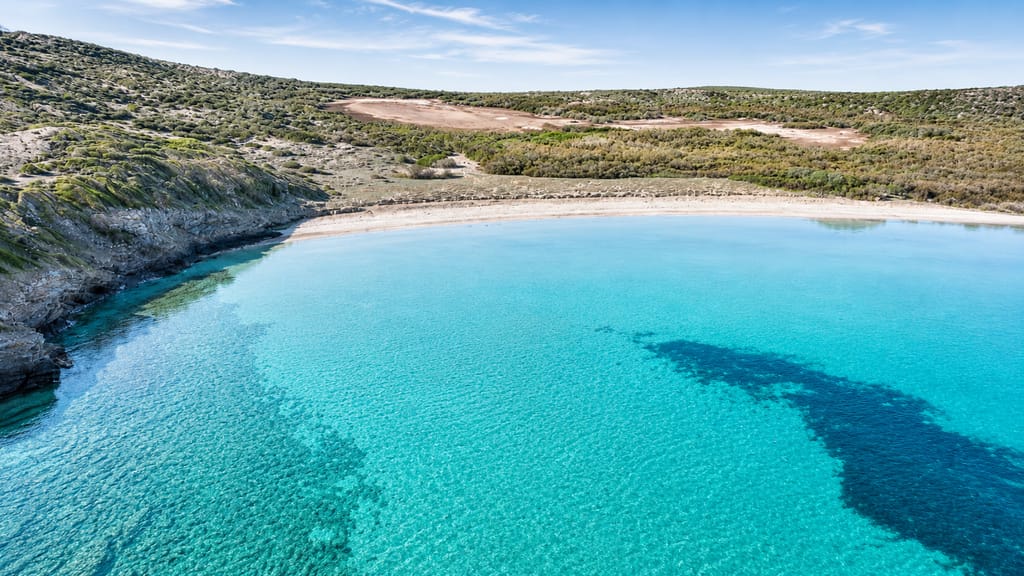
Menorca's unspoilt coves are the ones that the tarmac never reached: no beach bar, no seafront promenade, not a building in sight, often not even a road that brushes past them. They are scattered along both of the island's coasts, north and south, and nearly all of them share the same thing: to get there you have to walk a fair while along the Camí de Cavalls or come in by sea. That is exactly what has saved them from the crowds.
In this guide I'll tell you which they are, what makes them genuinely unspoilt, how you reach each one and, above all, how to enjoy them without spoiling them, because with this kind of cove that's half the story. I'm writing it from Es Canutells, on the south coast, where I keep the llaüt and from where I see a good stretch of this coastline every season.
What makes a cove unspoilt
"Unspoilt" gets thrown around freely in the brochures, so it's worth being clear. An unspoilt Menorcan cove isn't just a pretty cove: it's one with no development and no services. No bar, no kiosk, no showers, no toilets, no lifeguard, no bins. In many cases there isn't even a road that reaches it, and the car stays a long way off or simply can't get in at all.
There are three reasons Menorca keeps so many. The first is the Biosphere Reserve declared by UNESCO in 1993, which put the brakes on construction when other islands were already built right up to the shore. The second is the Camí de Cavalls, the historic 185-kilometre path that rings the whole island: thanks to it you can reach on foot coves that would otherwise be out of reach, but that walk also acts as a filter. And the third is the protected natural areas —the Parc Natural de s'Albufera des Grau, the northern Marine Reserve and a good number of ANEI (areas of special natural interest)— where building is banned.
The result is an island with dozens of sandy bays in an almost wild state. It's not that they're hidden: they're on the maps. It's just that getting there takes effort, and that little bit of effort keeps the feel of the place.
The unspoilt coves of the south
The south of Menorca is the coast of white sand and turquoise water. Here the coves are the mouth of a ravine: a dry torrent that runs down between limestone walls, with pine woods almost to the shore, opening onto a pale sandy bay. The water turns those turquoise shades because the bottom is fine sand.
The unspoilt ones in the south are concentrated in the central stretch, the Migjorn, where there are no tourist resorts. Some have restricted vehicle access in summer; others, none at all.
Cala Escorxada is the textbook example. It sits in Es Migjorn Gran, between Cala Trebalúger and Sant Tomàs, and it's the same as it was fifty years ago: no road, not a single building. You only reach it on foot along the Camí de Cavalls, between an hour and a half and two hours of walking, or by sea. Its immediate neighbour, Cala Fustam, is even more remote.
Cala Binigaus, also in Es Migjorn Gran, is a long beach of pale sand west of Sant Tomàs. There's no vehicle access to the sand: you walk down for about 15-20 minutes. Behind it opens the Barranc de Binigaus, one of the most spectacular ravines on the island.
In the south-west, in the municipality of Ciutadella, are the big names that still hold out as unspoilt: Son Saura, Es Talaier and Cala Turqueta. They are protected sandy bays, with shallow, calm water and a paid car park that fills up early in July and August. Unspoilt in their landscape, yes, but the most visited of the group precisely because of their fame.
You'll find the rest of the south coast laid out, cove by cove, in the guide to the coves of southern Menorca.
The unspoilt coves of the north
The north is another Menorca. Here the rock changes colour: the reddish, iron-rich tones appear, the sand leans towards ochre or gold, and the landscape is wilder, with less pine and more scrubland. This is the coast of the Tramuntana, the north wind that blows hard and shapes everything: when you can bathe in peace, when a boat can anchor and when it's best to stay in the south.
A good part of the north lies within protected areas, so the concentration of unspoilt coves is very high.
Cala Pregonda, in the municipality of Es Mercadal, is the most iconic in the north. Reddish sand, with rocky islets rising out of the water —the Escull de Pregonda— and an almost Martian feel. There's no car access: you reach it on foot in a walk of about two kilometres with no shade, or by sea. Its neighbour, Cala Pregondó, is more hidden still. Both lie within the northern Marine Reserve.
In the Favàritx area, inside the Parc Natural de s'Albufera des Grau, are Cala Tortuga and Cala Presili, two unspoilt bays with a stark landscape —Presili has that characteristic dark slate— that you walk down to from the lighthouse car park. Further south, towards Es Grau, the coast turns genuinely remote: Cala Pudent, the sandy bay of Mongofre or Cala Morella are reached only along the Camí de Cavalls or by water, and off Es Grau lies the Illa d'en Colom, the largest island off the Menorcan coast, uninhabited and reachable only by sea.
The full run of the north, with the Tramuntana warning and the rules of each protected area, is in the guide to the coves of northern Menorca.
How you reach an unspoilt cove
By definition, you don't reach an unspoilt cove comfortably. There are three ways, and it pays to know what each one asks of you.
On foot along the Camí de Cavalls. It's the classic way and, for many coves, the only one by land. The path rings the whole island in 20 waymarked stages, and from it branch off the tracks that drop down to the coves. The walks range from the 15 minutes of the most accessible to the good two hours of the remote ones. It's uneven ground, with climbs, descents and little shade on the high sections. Closed shoes, plenty of water, a hat and sun cream: there's no spring or bar along the way.
By car. It works for some of the south-western ones (Turqueta, Son Saura) and for a few in the north (the Favàritx area), but with caveats: paid car parks that fill up by mid-morning, barriers and a shuttle bus in summer —as at Macarella— and tracks in poor condition in the north. You get close, not to the sand, and there's always a final walk left.
By sea. For the coves with no vehicle access, the boat is one of the most practical ways: it spares you the walk and drops you right in front of the sandy bay, linking one cove to the next with no queues. Now, here it's only fair to be honest, which is how we work: the sea decides. Departures depend on the wind and the state of the sea on any given day, and no particular cove is guaranteed. With a strong Tramuntana the north closes off and we head for the south; with an easterly or a swell it can be the other way round. The route is put together each morning by looking at the forecast. If you want to see how we plan our outings according to the conditions, you'll find it in our boat trips around Menorca.
How to enjoy them with respect
This is what really tells an unspoilt cove apart from a developed one: here there's no one behind you clearing up what you leave. The cove stays as it is because the people who go there behave. Four things worth being clear about.
- What comes in with you, goes back out with you. There are no bins. All the rubbish, cigarette ends and food scraps included, goes back down with you. A small bag in the rucksack sorts it.
- Look after the posidonia. Those green meadows you see under the water are posidonia, a protected sea plant that's what keeps the water so clean and the seabed alive. You don't pull it up or tread on it when it's near the shore, and boats can't drop anchor on top of it: anchoring on posidonia is banned and it's policed with fines. Anyone sailing sensibly drops anchor only on sand or uses a mooring buoy.
- Respect the protected area. Many of these coves are in a natural park or marine reserve. That means no fires, no camping where you can't, not disturbing the wildlife and, on protected islets like the Illa de l'Aire or the Illa d'en Colom, respecting the areas where you can't land or anchor.
- Go prepared, because there are no services. No water, no guaranteed shade, no phone signal in many cases. Take plenty of water, food, sun protection and something to cover yourself from the midday sun. Download the maps before you set off.
None of these rules is a whim. They are exactly what has made it possible for these coves to still be what they are after decades of tourism on the island.
When to go
The bathing season in Menorca runs from late May to October, with the warmest water between July and September. For an unspoilt cove, the best time is first thing in the morning or mid-afternoon: you dodge the midday heat and, above all, you find the cove emptier. In August even the remote ones get boats anchored off the sand, so an early start makes the difference.
The other factor is the wind. In the south, the trouble is a southerly component, which spoils the anchoring and the approach; in the north, the Tramuntana. A calm day or one with a light wind off the opposite coast is gold for any plan at an unspoilt cove, whether you go on foot or by sea.
If what tempts you is getting to know this coastline from the water, with no walks and no queues, give me your date and we'll fit it in around the sea on those days. You'll find the outings and availability in our routes around Menorca, and the overview of the whole island, cove by cove, in the general guide to the coves of Menorca.
Frequently asked questions
Which are the most unspoilt coves in Menorca? In the south, Cala Escorxada, Cala Fustam, Cala Trebalúger and the Binigaus coastline are among the most pristine, with no vehicle access. In the north the standouts are Cala Pregonda, Cala Pregondó, Cala Pudent and the sandy bay of Mongofre. Nearly all of them are reached only on foot along the Camí de Cavalls or by sea.
Do Menorca's unspoilt coves have services? No. By definition, an unspoilt cove has no bar, showers, toilets, lifeguard or bins, and many have no access road either. You have to bring water, food and sun protection, and take your own rubbish back, as they're usually in protected areas.
How do you reach Menorca's unspoilt coves? In three ways: on foot along the Camí de Cavalls (from 15 minutes to over two hours depending on the cove), by car to a nearby car park where one exists (several fill up early or have restricted access in summer) or by sea, which for the coves with no vehicle access is one of the easiest ways.
Can you go to the unspoilt coves by boat? Yes, and it's one of the best ways to get to know the ones with no road. That said, the route always depends on the wind and the state of the sea on any given day: no particular cove is guaranteed, and it's decided each morning according to the conditions.
Why can't you anchor on posidonia? Because posidonia is a protected sea plant that keeps the water clean and the seabed alive, and the anchor wrecks it. Anchoring on it is banned in the Balearics' protected areas and is policed with fines. Responsible boats anchor only on sand or use eco-friendly mooring buoys.
When is the best time to visit the unspoilt coves? Between late May and October, with the warmest water from July to September. To find them quiet, it's best to go first thing in the morning or mid-afternoon and pick a day without a strong wind off the coast the cove faces.
See the coves from the water
If you'd like to see the unspoilt coves at their best, with no hiking, tell me your date and we'll plan the trip around the sea that day.
Check available dates