
Beaches of southern Menorca: full guide
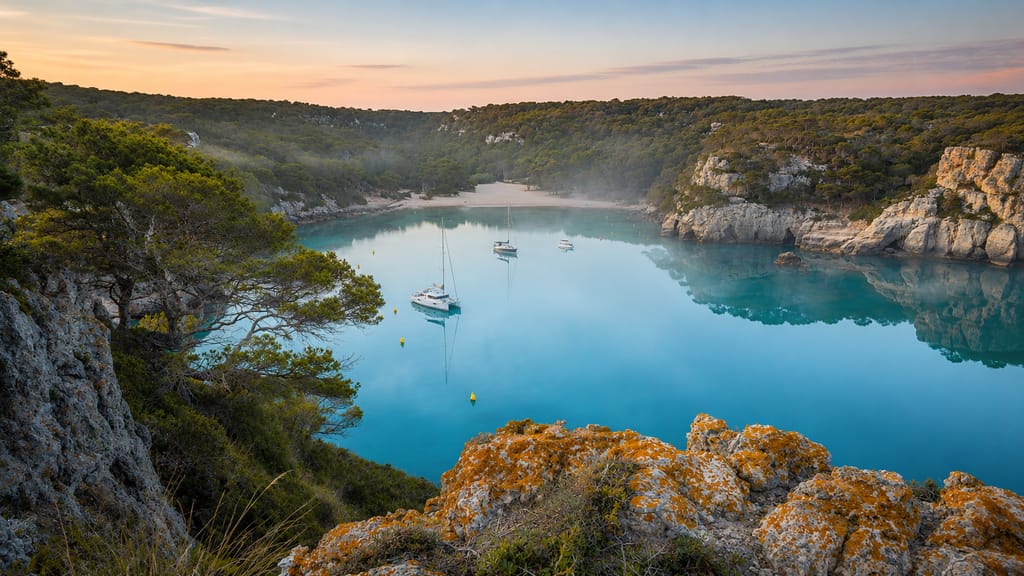
The coves of southern Menorca are the ones on the postcard: fine white sand, turquoise water and low limestone cliffs with pine woods reaching almost down to the shore. This is the Migjorn coast, more sheltered from the tramuntana than the north, and that is why it keeps that Mediterranean Caribbean look so well. This guide runs through every cove in the south, area by area: where they are, how you reach each one, which remain unspoilt and what each cove has that earns the trip.
It is worth being clear about one thing from the start: two worlds sit side by side in the south. On one hand, the unspoilt southern coves with no development and barely any facilities, many with no road access, reached only on foot along the Camí de Cavalls or by sea. On the other, holiday resorts such as Cala Galdana or Son Bou, with parking, hotels and everything to hand. Both have their moment; the important thing is to know what you are heading for before you leave home.
Geographically the south splits into two stretches. The south-west runs from Ciutadella to Cala Galdana and holds the most famous string of unspoilt coves on the island. The south-east runs from Cala Galdana to Maó, mixing developed coves with hidden gems and ending in the fishing-village country of the south-east. Let us take them in order.
Beaches of the south-west (from Ciutadella to Cala Galdana)
This is the stretch of the unspoilt beaches of southern Menorca par excellence. Almost all share the same character: pale sand, shallow clear water, pine woods behind and no facilities on land. In summer they get very busy precisely because of their fame, so the earlier you go, the better.
Son Saura
The westernmost of the unspoilt stretch, in the municipality of Ciutadella. Son Saura is in fact a wide bay with two stretches of sand (Bellavista and des Banyul) separated by pine woods. You reach it by car as far as a paid car park on private land and then a walk through the wood, or on foot along the Camí de Cavalls, or by sea. It is unspoilt, with no development. What makes it special is the sheer breadth: very shallow water over sand, ideal for a quiet swim and for gentle snorkelling. You have the details on how to get there in the Son Saura guide.
Es Talaier
Small, snug and among the prettiest on the stretch, tucked between Son Saura and Turqueta. It has no direct road access: you reach it after a walk or by sea. It is unspoilt, with sheltered and very shallow water, which makes it a popular anchorage and a good spot for snorkelling without swell. More on this in the Es Talaier guide.
Cala Turqueta
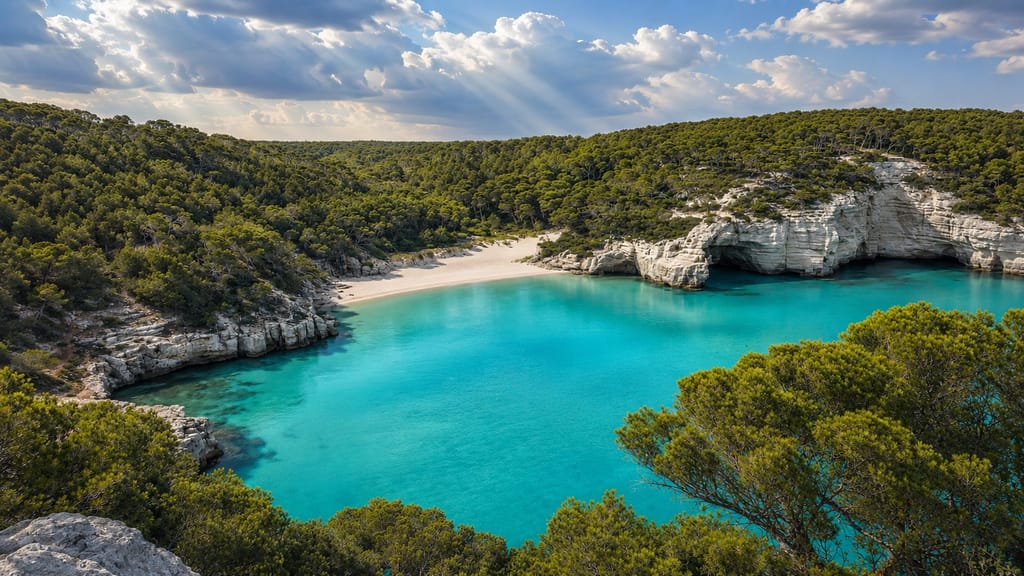
One of the most sought-after and photographed coves in all of Menorca, in Ciutadella. You reach it by car as far as a car park and a short walk, by the Camí de Cavalls or by sea. It is unspoilt, sheltered between pine-clad cliffs, with calm shallow water: the classic place to anchor and bathe in peace. It is also one of the few south-western coves our boat can reach on a full-day outing, depending on the sea and the wind. I tell it without promises in the Cala Turqueta guide.
Cala Macarella and Macarelleta
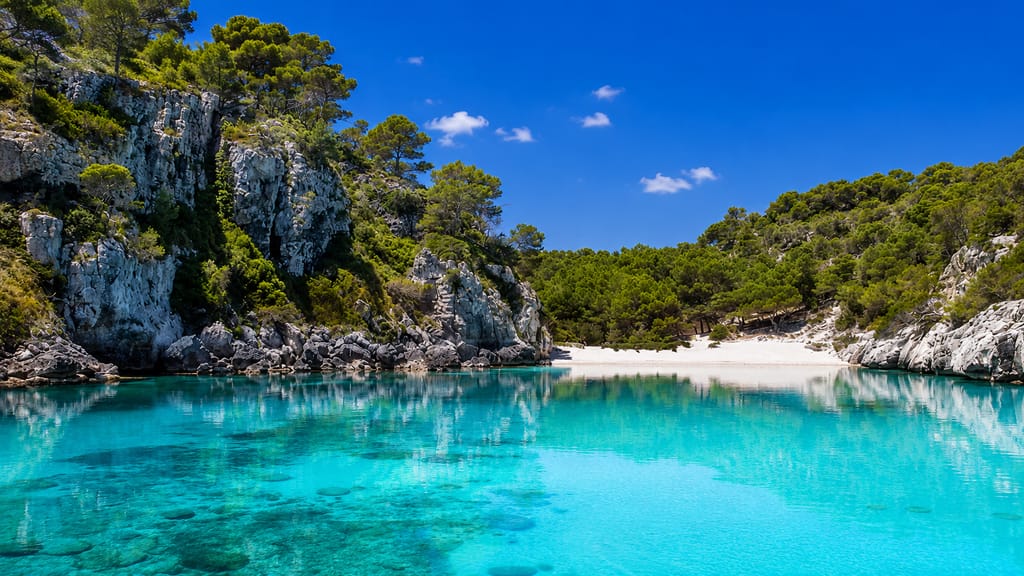
Macarella is the brand image of Menorca: white sand, water of an unreal turquoise and pine woods spilling down over the cove. Out of season you reach it by car; in summer (June to September) there is a barrier and a shuttle bus. On foot, a short path links it with its little sister, Macarelleta, snugger and also unspoilt. Both are very popular anchorages; in the height of August you will see dozens of boats. If you want to go by sea with a skipper, there is the boat trip to Cala Macarella.
Cala en Bosc
At the far south-west, next to Son Xoriguer (Ciutadella). It is not an unspoilt cove: it is a marina and yachting harbour, a developed area with facilities. It works as a starting and mooring point for boats rather than as a cove for anchoring and bathing. We mention it to place you, but it is not a wild-coast destination.
Cala Galdana
The big holiday resort of the south, in the municipality of Ferreries. A horseshoe bay, very sheltered, with hotels, parking and every facility. It is not unspoilt, but it plays a key role: it is the usual base from which people set out (on foot or by hire boat) towards the neighbouring unspoilt coves such as Mitjana, Macarella or Trebalúger. Several stages of the Camí de Cavalls start here. More context in the Cala Galdana guide.
Cala Mitjana and Mitjaneta
East of Galdana, in Ferreries. Mitjana is one of the most accessible unspoilt coves in the south: an easy 15-20 minute walk through pine woods from a car park, or the Camí de Cavalls, or by sea. White sand, sheltered water and the cliffs some people jump off into the water. Right beside it, Mitjaneta is smaller and a little harder to reach on foot (you have to scramble over some rock). If reaching it by boat appeals, there is the boat trip to Cala Mitjana.
Cala Trebalúger
One of the most prized unspoilt coves in the south, between Mitjana and Escorxada. It has no road access: either you walk for more than an hour along the Camí de Cavalls, or you arrive by sea. Fine white sand, a freshwater stream at the foot of the ravine and very few people compared with its neighbours. Because of its isolation, arriving by sea is one of the most comfortable ways to get to know it; there is the boat trip to Cala Trebalúger.
Cala Escorxada
Isolated and pristine, on the stretch between Trebalúger and Sant Tomàs. No road access: an hour and a half or two hours of Camí de Cavalls, or by sea. It is one of the most unspoilt and least visited coves in the south precisely because of how hard it is to reach on foot. Pale sand, a wholly natural setting and the feeling of having it almost to yourself. I go into it in the Cala Escorxada guide.
Cala Fustam
Next to Escorxada and with the same profile: remote, unspoilt, little visited, with no car access. You reach it by a remote stretch of the Camí de Cavalls or by sea. If Escorxada is already solitary, Fustam tends to be even more so. It shares fine sand and a protected setting with its neighbour, and is usually visited on the same walk or outing as Escorxada.
Beaches of the south-east (from Cala Galdana to Maó)
The eastern stretch is more of a mix: here you find comfortable holiday resorts, coves with prehistoric remains and, towards the south-east, the fishing villages near Maó. It is also the area closest to Es Canutells, our home port.
Cala Binigaus
In Es Migjorn Gran, west of Sant Tomàs. It is unspoilt, a long beach of pale sand with cliffs, with no direct road access to the sand: you reach it on foot in 15-20 minutes from Sant Tomàs or by sea. Its size and open character set it apart from the small, boxed-in coves of the west. You have the details in the Cala Binigaus guide.
Platja de Sant Tomàs
A holiday resort next to Binigaus, in Es Migjorn Gran. It is not unspoilt: parking, facilities and access right onto the beach. It is the comfortable option in the area and the natural starting point for walking to Binigaus. Nearby lies the islet of Binicodrell, a pretty touch from the water.
Platja de Son Bou
The longest beach in Menorca, in Alaior. Direct access by car with parking; its main stretch is not unspoilt, being developed and with facilities. But its eastern end, wilder, gains a great deal seen from the sea, and beside the beach lie the remains of an early Christian basilica. It is that contrast between an endless touristy strand and a natural corner that makes it distinctive. More in the Son Bou guide.
Cala en Porter
In Alaior, at the mouth of a ravine. It is not unspoilt (there is an urban area up top and steps down), but its entrance between great cliffs is among the most imposing in the south, and up above sits the famous Cova d'en Xoroi. It is a sheltered cove and spectacular from the water. If you want to see it under sail, there is the boat trip to Cala en Porter.
Cales Coves
East of Cala en Porter, in Alaior. It is unspoilt and singular: a double cove flanked by a prehistoric necropolis carved into the cliffs, with dozens of burial caves. It has no direct road access (a footpath or by sea), and is best enjoyed from the water, where you can take in the cave-pierced rock face. I tell it in the Cales Coves guide.
Cova des Coloms
Inside the Barranc de Binigaus, Es Migjorn Gran. It is worth clarifying: it is not a cove and is not reachable by sea. It is a cave inland, enormous (hence the nickname "the Cathedral"), reached only on foot along the ravine. We include it because many people look for it within this area, but it is a land-based point of interest, not a bathing spot. You have the information on the Cova des Coloms.
Es Canutells
About 12 km from Maó. It is a narrow, sheltered inlet, with housing on the slopes, so it is not unspoilt. For us it is special for one specific reason: it is our home port. From here the Capeador 43 sets off each day towards the southern coves.
Cala Binidalí
Near Es Canutells, west of Binibèquer (municipality of Maó). It is wedged between cliffs, with a small patch of sand on land and nearby housing, but it keeps an unspoilt air and is very photogenic from the water. You reach it by car and down some steps. Because of its contained size and its rock walls, it gains a great deal seen from the sea. More in the Cala Binidalí guide.
Binibèquer Vell and the Sant Lluís area
Towards the south-east, now in Sant Lluís, the coast fills with small coves and villages. Binibèquer Vell is the famous "white village" of whitewashed alleyways, from 1972, more appealing for its look than for its swimming. Around it, coves such as Cala Torret or Punta Prima (opposite the Illa de l'Aire) are developed and easy to reach by car, with clear water but without the wild character of the west. Useful if you are after comfort and facilities near Maó.
Cala Alcaufar
In Sant Lluís, about 8 km from Maó, next to S'Algar. It is a former fishing village that stays uncrowded, with a sheltered inlet, an islet at the mouth and an 18th-century defence tower. It is not unspoilt, but it keeps the quiet charm of fishermen's coves and links up with the Camí de Cavalls. More details in the Cala Alcaufar guide.
Cala Rafalet
Right beside S'Algar, in Sant Lluís. It is unspoilt and very particular: a narrow, deep cleft wedged between cliff walls, at the end of the Barranc de Rafalet. It has no road access; you walk down the ravine from S'Algar. Arriving by sea avoids that walk and lets you appreciate how close its walls are. It is small and shady, unlike any open strand of the Migjorn.
Better by boat: the southern coves with no road access
If anything unites the best unspoilt coves in the south, it is that they are hard to reach. Several have no car access: either you walk a long way along the Camí de Cavalls under the sun, or you come in by sea. These are the ones that gain the most by arriving under sail:
- Cala Trebalúger — over an hour on foot; by sea you arrive straight in.
- Cala Escorxada and Cala Fustam — an hour and a half or two of walking; among the most isolated in the south.
- Cales Coves — to take in the cliff necropolis, the water is the best vantage point.
- Cala Binigaus — no road access to the sand; the boat makes it much more comfortable.
- Cala Rafalet — boxed in at the end of a ravine; by sea you save yourself the way down and back up.
We set off from Es Canutells in the Capeador 43, a 9-metre Menorcan llaüt for a maximum of 7 passengers, with a qualified skipper. The main route follows the southern coast, and on a full-day outing it is possible to reach as far as Cala Turqueta or Macarella if the sea allows. I say it as we work: we do not promise to always reach a specific cove, because the route depends on the sea and the wind on any given day. But the south is our backyard. If you want to see the options, take a look at our boat trips around Menorca and the boat hire prices, or book your boat trip directly.
Frequently asked questions about the beaches of southern Menorca
Which are the unspoilt beaches of southern Menorca?
The main unspoilt coves in the south are Son Saura, Es Talaier, Cala Turqueta, Macarella and Macarelleta, Cala Mitjana, Cala Trebalúger, Cala Escorxada, Cala Fustam, Cala Binigaus, Cales Coves and Cala Rafalet. They share white sand, clear water and the absence of development and facilities on land.
What is the difference between the southern and northern beaches of Menorca?
The south has fine white sand, turquoise water and limestone cliffs, and is more sheltered from the wind. The north is more reddish and iron-rich, with a rugged landscape and very exposed to the tramuntana. We go into it in the guide to the beaches of northern Menorca.
Which southern beaches can you not reach by car?
Cala Trebalúger, Cala Escorxada, Cala Fustam, Cala Binigaus and Cala Rafalet cannot be reached by car: only on foot along the Camí de Cavalls or by sea. Son Saura, Es Talaier, Turqueta, Macarella, Mitjana and Cales Coves have parking or a shorter walk depending on the cove.
Which is the best beach in southern Menorca?
It depends on what you are after. For fame and the postcard, Macarella and Turqueta; for unspoilt peace and quiet, Trebalúger, Escorxada or Fustam; for something singular, Cales Coves with its necropolis. The busiest in summer are Macarella, Turqueta and Mitjana, so for those it pays to get up early.
Are there facilities at the unspoilt beaches in the south?
At the unspoilt ones, usually none: no bar, no showers, no toilets, no lifeguard, no bins. You need to bring water, something to eat, sun cream and a bag for your rubbish. Cala Galdana, Son Bou, Sant Tomàs and Cala en Porter do have facilities and infrastructure.
When is the best time to visit the southern beaches?
The swimming season runs from May to October. July and August are the busiest and hottest months; June and September usually offer good water temperatures with fewer people. In any month, going early makes all the difference at the most popular coves.
This is one of the two area guides; you have the overview of the whole island in the full guide to the beaches of Menorca and the other stretch in the guide to the beaches of northern Menorca.
Discover the southern coves by boat
If you want to reach the south's most unspoilt coves the way they look best, from the water, tell me your date and we'll put the trip together according to the sea that day.
Check available dates