
Platja de Cavalleria (Menorca): how to get there and what to see
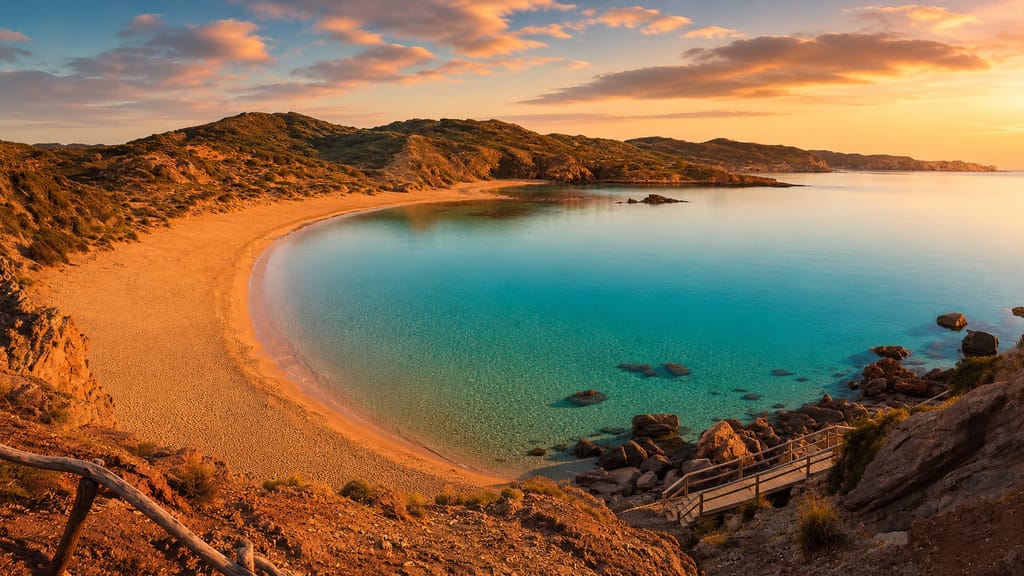
If in the south of Menorca you go looking for little white coves tucked between the pines, Cavalleria is the exact opposite: an open, wide beach of dark sand, in one of the most rugged areas of the north. It sits in the municipality of Es Mercadal, near Cap de Cavalleria, the northernmost tip of the island, where the 1857 lighthouse and the cliffs set the scene. It is one of the big northern beaches you can reach comfortably by car, and that makes it a good first taste of this coast.
What makes it special is the contrast. Here the land turns reddish and ochre, there are fewer pines and more rock and low scrub, and the sea comes in head-on to the Tramuntana. When the north is calm, you get a wide, bright beach; when it blows, you see the other face of Menorca, the one of swell and wind. A few kilometres away you have two visits well worth it in their own right: the Far de Cavalleria and the Roman site of Sanitja.
Where it is and what it's like
Cavalleria belongs to the north coast, the one that faces the Tramuntana, and forms part of the Cap de Cavalleria area. It is neither a virgin nor a hidden cove: it is a wide, well-known beach with a fair amount of footfall in summer, but it still keeps a very strong natural setting, with no development right up against the sand.
The landscape here changes from the south. Less pine running down to the water, more earthy colours, open rock and that feel of an exposed coast. The sand is darker in tone, in keeping with the area's geology, and the whole scene, with the cape and the lighthouse in the background, is one of the most photogenic in the north. Nearby is Sanitja, an old natural harbour with Roman remains, and the lighthouse, which offers some of the best views of this entire corner of the island.
How to get to Platja de Cavalleria
By car and parking
This is the easy part: you can drive to Cavalleria. From Es Mercadal or from Fornells you take the road towards Cap de Cavalleria and there is a dedicated car park; from the car park it is barely about a 5-minute walk to the sand. In summer the car park fills up early, so it is worth getting there first thing or in the late afternoon if you don't want to drive around in circles.
Unlike many of the virgin coves in the north, here you don't have to do a long walk or a technical trail to reach the water. That makes it easy for a day with children, or if you don't fancy walking under the sun with no shade.
On foot, along the Camí de Cavalls
Cavalleria is also on the route of the Camí de Cavalls, the path that rings the whole island, so you can arrive on foot by linking up with neighbouring stretches. If you combine it with the coves nearby, you have enough for a full day of north coast. Take water, a cap and closed shoes: this area has little shade and the northern sun is just as fierce as in the south.
By sea
The other way to get to know this coast is from the water. The north of Menorca, with the cape, the cliffs and the islets, looks different from the sea, and seeing the whole coastline while sailing has its appeal. That said, it is a coast very exposed to the Tramuntana: when it blows from the north, the sea here gets up and it is no place to go near.
Our llaüt sets off from Es Canutells, on the south coast, and we sail south or north depending on the day, on how the sea and the wind are. I'm not going to promise you we'll go to Cavalleria on a particular trip, because it depends on the weather and I would rather not sell you smoke. What I can do is tell you what is within reach that day and put together a route worth doing. If seeing the north coast by sea is on your mind, take a look at the routes and we'll talk it over.
What you'll find
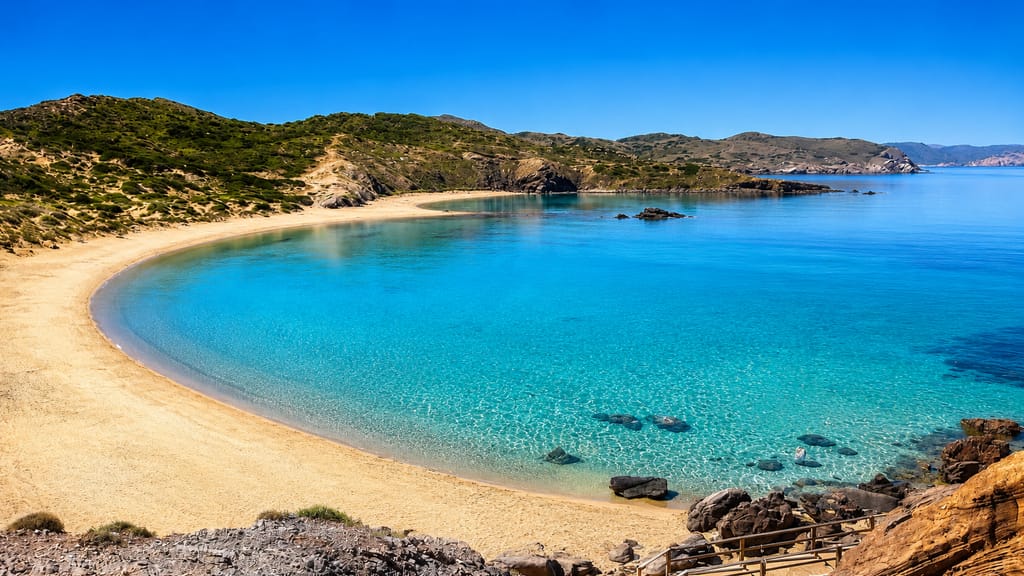
Cavalleria is a wide beach of dark sand, with plenty of room even on busy days. The water comes in clear and, when calm, makes for a quiet swim; with a northern swell it changes, and you have to watch out for the current.
For snorkelling, the rocky areas at the ends of the beach are the most interesting, with rocky bottoms and rock-dwelling fish. It isn't a turquoise-water aquarium like the southern coves, but it has its own biodiversity and it is worth bringing mask and snorkel if the sea cooperates.
In terms of services, Cavalleria is better equipped than its neighbouring virgin coves: it usually has some seasonal facilities and lifeguards in summer, though it is not an urban beach with every comfort. The sensible thing is to come prepared all the same, with water, food and your own shade, because the natural kind is scarce. And, as everywhere in the north, what comes in with you goes out with you: respect the surroundings and take your rubbish away.
Best time and tips
- When to go. June and September are the best: mild water and far fewer people than in the height of August. In high season, especially at midday, the car park and the sand feel full.
- The wind rules. This is north coast, open to the Tramuntana. With a north wind there is swell and the beach loses its charm; with a southerly or calm is when it shines. Check the forecast before settling on the day.
- Get there early for the parking. In summer it fills up early. Arriving first thing secures you a spot and leaves you a quieter beach.
- Make the most of the surroundings. Combine it with the Far de Cavalleria and the Sanitja site: on a single trip you get beach, lighthouse and Roman history.
- Shade and sun. There is little natural shade. Bring a parasol, a cap and sun protection, and plenty of water.
Neighbouring coves
If you plan your day around this part of the north, it makes sense to string a few together. Right next to Cavalleria, towards Binimel·là, is Cala Mica, much smaller and unspoilt, with good snorkelling inside the Marine Reserve. And between Cavalleria and Binimel·là lies Cala Barril, solitary and a long walk to reach, for anyone after real solitude.
To get your bearings on the whole, two reads will help: the guide to the coves of northern Menorca, with the beaches of this coast and how to reach each one, and the complete guide to the coves of Menorca, with south and north. If what you fancy is seeing the coast from the sea, on the boat routes page I explain how we work depending on the day.
Frequently asked questions
How do you get to Platja de Cavalleria?
By car, along the Cap de Cavalleria road from Es Mercadal or Fornells. There is a dedicated car park and from there it is about a 5-minute walk to the sand. You can also arrive on foot along the Camí de Cavalls.
Can you drive all the way to Cavalleria?
Yes. Unlike many of the virgin coves in the north, Cavalleria has road access and parking, with a short walk of about 5 minutes to the beach. In summer the car park fills up early, so it is worth going early.
Is Cavalleria a virgin beach?
Not entirely. It is a wide, well-known beach, with some seasonal facilities, but it keeps a very strong natural setting, with no development right up against the sand and within the Cap de Cavalleria area.
What is there to see near Cavalleria?
The Far de Cavalleria, at the northern tip of the island, with excellent views, and the Roman site of Sanitja, an old natural harbour. Both are a few kilometres away and can be combined with the beach on a single outing.
When is the best time to visit Platja de Cavalleria?
In June or September, with mild water and fewer people. As it is north coast, it is best to avoid days of Tramuntana: with a north wind the sea gets up and the beach is less comfortable for swimming.
Want to see it from the water?
Tell us your date and we'll plan the trip around the sea that day.
Check available dates